World Stadium EX
The first PlayStation 1 game in Namco’s incredibly long-running and variously-named series that includes the first R.B.I. Baseball game, Super Batter Up, Extra Bases on the Game Boy, and the Family Stadium/Famista games. Namco lightly dips its toes into the world of 3D with World Stadium EX, presenting 3D-modeled stadiums with 2D player sprites laid on top of them.

| JP Title | ワールドスタジアムEX |
|---|---|
| Release Date | Japan: July 26 1996 |
| Platforms | PlayStation |
| Developer | Namco |
| Publisher | Namco |
| Team Names | Real NPB teams |
| Player Names | Real NPB players |
| Cover Athlete(s) | Ichiro Suzuki is the sliding #51 on the cover art |
| Preceded by | Super Famista 5 (Super Famicom) |
| Followed by | World Stadium 2 |
Gameplay Video
Description
If you’re familiar with 1987’s R.B.I. Baseball on the NES, it may come as a shock to know that in Japan, they have been making sequels to that very popular game for more than 30 years now, totally separate to everything that came out under the R.B.I. Baseball name in North America. The first game was called Family Stadium in Japan, after the Japanese name for the NES console, the Family Computer, later officially truncated to Famista. For the handful of games that came out on non-Nintendo consoles, the series is called World Stadium instead in order to not borrow half of a Nintendo trademark.
By the time of World Stadium EX, Namco’s baseball game series has developed a strong personality: Cartoon graphics, zany doo-wop music with sped-up-sounding vocals, and a Smash Bros.-like willingness to pull in anything and everything from old Namco arcade games. In this game, you can either play as Ichiro and Hideki Matsui in a normal stadium, or you can play as Pac-Man and Kazuya while listening to music from Rally-X and playing in a stadium based on Xevious.
The normal modes are here: Open mode to play a single game against the CPU or Player 2, Pennant Race to play a season (10, 30, 60, or 130 games long), and a Practice mode that helpfully shows you what determines the quality of contact when you’re hitting. A Create a Character mode is also here, letting you choose a team to add your custom-named and slightly visually-customizable player to, then takes you through a series of minigames to determine your player’s attributes.
Each individual game you play generates an attractive virtual “Namco Sports” newspaper broadsheet that’s about eight times the size of your screen. You can scroll around it to look at the game’s stats and some goofy fake advertisements. These newspapers can be saved to your memory card to see again later.
Roster
World Stadium EX includes real team names and players for Nippon Professional Baseball, the Japanese league, as of the start of the 1996 season. Some notable players:
- Orix Blue Wave – Ichiro Suzuki
- Nippon Ham Fighters – Rob Ducey
- Seibu Lions – Darrin Jackson, Kazuo Matsui
- Osaka Kintetsu Buffaloes – Luis Aquino
- Chiba Lotte Marines – Jack Daugherty, Hideki Irabu
- Yomiuri Giants – Hideki Matsui, Hideki Okajima
- Hanshin Tigers – Glenn Davis, Tsuyoshi Shinjo
- Yokohama Bay Stars – Glenn Braggs, Kazuhiro Sasaki, Takashi Saito
- Yakult Swallows – Hensley Meulens, Tom O’Malley
There are also a few fictional teams:
- The Namco Stars are a team stocked with characters from other Namco video games, like Pac-Man and Mitsurugi from Soul Edge/Soul Calibur.
- The World Stars have players named after both fictional and non-fictional world leaders, like Oda Nobunaga, King Arthur, and Zhuge Liang.
- The Kusayakyuu Errors are a Bad News Bears-esque kid’s team with low stats and helmets with cat ears. (Kusayakyuu literally means grass baseball. I would translate it as sandlot or amateur baseball.)
- The Mechanical Robots are robot players, named after mechanical parts like Motor and Piston.
Little Details
- Ichiro has a unique hitting animation. He kicks his front leg up and out as the pitch comes in.
- There are three wildly different audio settings available in the options menu. In the default setting, a stadium announcer reads out each player’s name as they come to bat. In the second option, “Comical,” some cartoon sound effects are added (“boing” noise when the ball bounces, for example) and arranged versions of music from other Namco games plays throughout at-bats. In the final option, team and player-specific fan chants/songs play during at-bats.
- Namco made a unique PS1 controller, the NeGcon (pronounced Nejicon from the Japanese word nejiru, meaning “to twist”), which allows for analog input by twisting the two halves of the controller. The controller was made primarily for racing games, but marketed as the best way to play their baseball games as well.
- You can press Select to switch between the windup and the stretch at any time while pitching. This struck me as an odd small detail for an arcade-style baseball game.
- Some more game design whimsy: When you boot up the game, you will see an intro cinematic showing a day game and a daytime version of the start screen. Wait long enough at the start screen and the intro will play again, but this time set at night, and then the start screen will also switch to a nighttime version. The start screen you press Start from determines whether the next exhibition game you play will be a day game or night game. Seems simpler to just give you a day/night button on the Stadium Select screen, but that just wouldn’t be in the spirit of a Namco baseball game.
Magazine Clippings
-
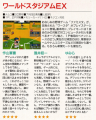
Reviews (out of 5 stars) from The PlayStation, Volume 33.
-

Preview from Famitsu, August 1996
-
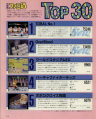
The weekly sales rankings from Famitsu issue 403, with World Stadium EX in third place.
-

An ad for the PlayStation console from The PlayStation, Volume 33. In the top-middle, Sae has recommended World Stadium EX for fans of sports games.


Secrets
- Automatically win the loading screen minigame – In the ball-collecting minigame, hold L1+R1+Triangle+Select+Down on D-pad to automatically collect every ball. It still takes some time to pull in every ball, so there’s no time to fumble around finding all the buttons after the minigame starts.
- Secret Riverbed Stadium – Collect 20 balls in the loading screen minigame, then when selecting a stadium, hover over the Xevious stadium then hold R while pressing Circle to select it. When the game loads, you will play in the quiet riverbed stadium that otherwise only appears in the game’s training and create-a-character modes.
- All players in perfect condition – After collecting all 20 balls in the loading screen minigame, press the X button to get a secret 21st point in the minigame. Now when you select Open in the main menu to play an exhibition game, your team’s players will all be in perfect condition and play to the top of their abilities.
Intro Cinematic
Credits
This is the cinematic seen when the Orix Blue Wave win the Nippon Series. The player models change to reflect the team you were playing as.
Commercial