Triple Play 97: Difference between revisions
From Baseball VG Encyclopedia
No edit summary |
No edit summary |
||
| (4 intermediate revisions by the same user not shown) | |||
| Line 10: | Line 10: | ||
| playernames = Real MLB players | | playernames = Real MLB players | ||
| coverathlete = Tony Gwynn | | coverathlete = Tony Gwynn | ||
| adaptedfrom = [[Pro Yakyuu Virtual Stadium]] | |||
| precededby = [[Triple Play 96]] | |||
| followedby = [[Triple Play 98]] | |||
}} | }} | ||
'''''Triple Play 97''''' is an early 3D baseball video game developed by EA Sports, a division of Electronic Arts, for PC and the Sony PlayStation. The game uses pre-rendered sprites of 3D-modeled players over 3D-modeled stadiums to simulate full 3D graphics, similarly to ''MLB Pennant Race'', released the same year for PlayStation. | '''''Triple Play 97''''' is an early 3D baseball video game developed by EA Sports, a division of Electronic Arts, for PC and the Sony PlayStation. The game uses pre-rendered sprites of 3D-modeled players over 3D-modeled stadiums to simulate full 3D graphics, similarly to ''MLB Pennant Race'', released the same year for PlayStation. | ||
| Line 15: | Line 18: | ||
== Gameplay Video == | == Gameplay Video == | ||
'''PlayStation''' | '''PlayStation'''<youtube>lWjufM1WbTY</youtube> | ||
<youtube>lWjufM1WbTY</youtube> | |||
'''PC''' | '''PC''' | ||
<youtube>DAU7qNG53es</youtube> | <youtube>DAU7qNG53es</youtube> | ||
== Description == | == Description == | ||
''Triple Play 97'' is the second game in the ''Triple Play'' series and second U.S.-released baseball game developed internally at EA Sports by the team sometimes known as Extended Play Productions, part of EA Canada. EA Sports developed two baseball games in 1995: ''Triple Play 96'', a 2D baseball game for Sega Genesis, and ''Pro Yakyuu Virtual Stadium'', a Japan-only baseball game for 3DO using 3D-modeled stadiums and pre-rendered sprites of 3D-style baseball players. ''Triple Play 97'' is an adaptation of ''Virtual Stadium'' | ''Triple Play 97'' is the second game in the ''Triple Play'' series and second U.S.-released baseball game developed internally at EA Sports by the team sometimes known as Extended Play Productions, part of EA Canada. EA Sports developed two baseball games in 1995: ''Triple Play 96'', a 2D baseball game for Sega Genesis, and ''Pro Yakyuu Virtual Stadium'', a Japan-only baseball game for 3DO using 3D-modeled stadiums and pre-rendered sprites of 3D-style baseball players. ''Triple Play 97'' is an adaptation of ''Virtual Stadium'' for the U.S. market and PlayStation console, with the same game design and some shared art and sound assets. The game includes all 28 Major League Baseball parks, 3D-modeled and with slick intro cinematics for each showing the camera flying down into the park from above. | ||
Any pitcher can throw any of the game’s ten pitches: “Slow” fastball, fastball, Changeup, curveball, screwball, slider, sinker, splitfinger, knuckleball, or pitchout. Each pitcher has different ratings for each pitch. Hitters can choose an open, closed, or normal stance before each pitch then make a normal swing, power swing, or bunt. Holding the D-pad in a direction will influence the ball to be hit in that direction (for instance, holding Up makes a flyball more likely, and left will hit the ball to the batter’s left). | Any pitcher can throw any of the game’s ten pitches: “Slow” fastball, fastball, Changeup, curveball, screwball, slider, sinker, splitfinger, knuckleball, or pitchout. Each pitcher has different ratings for each pitch. Hitters can choose an open, closed, or normal stance before each pitch then make a normal swing, power swing, or bunt. Holding the D-pad in a direction will influence the ball to be hit in that direction (for instance, holding Up makes a flyball more likely, and left will hit the ball to the batter’s left). | ||
| Line 61: | Line 64: | ||
File:Triple-Play-97-EGM-86.png|Tip about super created players using dev names, in Electronic Gaming Monthly, Issue 86 | File:Triple-Play-97-EGM-86.png|Tip about super created players using dev names, in Electronic Gaming Monthly, Issue 86 | ||
</gallery> | </gallery> | ||
== External Links == | |||
* [https://the-cauldron.com/an-ode-to-erik-kiss-virtual-home-run-king-a52a180396e9 An Ode to Erik Kiss: Virtual Home Run King essay by Stephon Johnson in Sports Illustrated: The Cauldron (Feb 29, 2016)] | |||
[[Category:Released in 1996]] | [[Category:Released in 1996]] | ||
[[Category:1990s]] | [[Category:1990s]] | ||
Latest revision as of 11:24, 12 November 2025
Triple Play 97

| Release Date | North America: June 24 1996 (PS1), September 24 1996 (PC) |
|---|---|
| Adapted From | Pro Yakyuu Virtual Stadium |
| Platforms | PlayStation, PC |
| Developer | EA Canada |
| Publisher | EA Sports |
| Original Price | $59.95 |
| Team Names | Real MLB teams |
| Player Names | Real MLB players |
| Cover Athlete(s) | Tony Gwynn |
| Preceded by | Triple Play 96 |
| Followed by | Triple Play 98 |
Triple Play 97 is an early 3D baseball video game developed by EA Sports, a division of Electronic Arts, for PC and the Sony PlayStation. The game uses pre-rendered sprites of 3D-modeled players over 3D-modeled stadiums to simulate full 3D graphics, similarly to MLB Pennant Race, released the same year for PlayStation.
Gameplay Video
PlayStation
PC
Description
Triple Play 97 is the second game in the Triple Play series and second U.S.-released baseball game developed internally at EA Sports by the team sometimes known as Extended Play Productions, part of EA Canada. EA Sports developed two baseball games in 1995: Triple Play 96, a 2D baseball game for Sega Genesis, and Pro Yakyuu Virtual Stadium, a Japan-only baseball game for 3DO using 3D-modeled stadiums and pre-rendered sprites of 3D-style baseball players. Triple Play 97 is an adaptation of Virtual Stadium for the U.S. market and PlayStation console, with the same game design and some shared art and sound assets. The game includes all 28 Major League Baseball parks, 3D-modeled and with slick intro cinematics for each showing the camera flying down into the park from above.
Any pitcher can throw any of the game’s ten pitches: “Slow” fastball, fastball, Changeup, curveball, screwball, slider, sinker, splitfinger, knuckleball, or pitchout. Each pitcher has different ratings for each pitch. Hitters can choose an open, closed, or normal stance before each pitch then make a normal swing, power swing, or bunt. Holding the D-pad in a direction will influence the ball to be hit in that direction (for instance, holding Up makes a flyball more likely, and left will hit the ball to the batter’s left).
Multiplayer with up to 8 players is possible with two Multitaps on the PlayStation version or up to 6 players on the PC version via modem connection or Gravis gamepads. Gameplay modes include Exhibition, Series, All-Star, Playoffs, Season, and Home Run Derby.
Roster
All 28 Major League Baseball teams are included with real team names and player names. Each team has a 25-man roster reflecting the 1996 Opening Day rosters. There is a Custom Player feature, with a limited number of attribute points that can be split between different skills.
Intro Cinematic
Demo Cinematic
Little Details
- After hitting a home run, pressing various face buttons during the home run trot will make different celebratory sound effects: For instance, Square makes an airhorn noise, Triangle makes a “Yeah!” sound.
- The loading screens and other information in-game present the game’s title as Triple Play 97: Virtual Stadium Baseball, but the box art makes no mention of “Virtual Stadium” except in the fine print as a trademark of Electronic Arts. It seems like the subtitle was dropped sometime between the game’s development and when the marketing was finalized.
- Buried in the sound options, you can select between three different genres of background music for the main menu: Rock, acidjazz [sic], and roots. “Acidjazz” is a slightly altered version of music made for Pro Yakyuu Virtual Stadium, a Japan-only baseball game developed by EA Sports for the 3DO console. The vocal track on “acidjazz” is a Japanese woman saying “Virtual Stadium,” “baseball game,” and “EA Sports.”
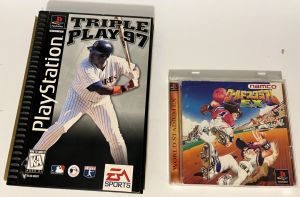
For comparison, Triple Play 97's tall box early printing next to a standard-sized PS1 game. - Triple Play 97 comes from the early part of the PlayStation’s history before Sony settled on the standard jewel case size and shape for game packaging. So the box for the original printing of Triple Play 97 is roughly the size and shape of a Sega CD box, tall with a plastic case with a ridged pattern on the front near the spine. A later printing came in the standard jewel case.

Cheats and Secrets
- To play on the hidden EA Sports Stadium on the PlayStation version, go to the Stadium Select screen and press L1, R1, L1, then hold R1 and press Start. EA Sports Stadium is a minor league-style park with developer in-joke fake advertisements on the outfield wall.
- This code makes it so that the next time you make contact with a swing, it will be a home run (or occasionally, a home run distance foul ball): Hold all shoulder buttons (L2+L1+R1+R2) then quickly press Up, Up, Triangle, Triangle, Up, Up, X, X. If you entered the code correctly, you will hear a confirmation chime.
- Entering one of the developer names from the Credits for a Custom Player will produce different kinds of super players with full attribute points. For example, entering Jon Spencer for a custom player produces a starting pitcher who can throw 160 MPH fastballs.
Credits
Magazine Clippings
-
Two-page Triple Play 97 ad from Electronic Gaming Monthly, Issue 85
-

Preview interview with Tony Gwynn from Electronic Gaming Monthly, Issue 85
-
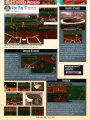
Preview from GamePro, Issue 94
-
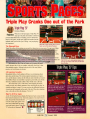
Review from GamePro, Issue 95
-

A review of Triple Play 97 from Electronic Gaming Monthly, Issue 84
-

Tip about super created players using dev names, in Electronic Gaming Monthly, Issue 86


